Two hundred years ago, music was a live event. You heard it once, in a room, with other people. Today, a song written in Lagos reaches a teenager in Seoul on the day of release. What happened in between was not just a technology story. It was a cultural, cognitive, and a biological one.
The entire human history is marked by introduction of technologies or abilities that have led to such evolution. They span from say introduction of languages and words, religion, cooking to electricity, the internet, and now it seems – Artificial Intelligence (AI).
Transformations like these have reshaped the way our brains are wired, how we think, what we value, and how we behave. They also affect the way ideas are created, selected, and passed on. In evolutionary biology terms, that is variation, selection, and transmission that govern the intensity of these transformations.
Variation is simply the variety of traits that exist due to various factors (like reproduction, environmental, randomness, etc.). Selection is the messy process where the fittest traits survive. And finally, transmission, is the inheritance of selected traits.
To understand this, let’s take music technology as an example. It not just participated but controlled all three.
From Tansen to Taylor Swift: How Technology Transformed Music
The advent of technology proved to be a boon for music. It boosted variation by enabling new kinds of music to be created by generating sound with the help of different technologies. For example, the invention of synthesizers in the 20th century let musicians create new sounds. They could explore textures that acoustic instruments couldn’t reach.
Selection has been in the hands of a few who control the lion’s share of listening minutes. It was in the hands of DJs at radio stations in the 20th century. Today, recommendation algorithms of streaming and social media platforms select songs with high retention as well as highest danceability, energy and positivity.
Transmission was re-designed too. Imagine yourself in the 16th century. Your favourite artist, Tansen, sang his latest music. You wouldn’t have been able to listen to him unless you attended it live inside Akbar’s courtroom. There was no storage medium except a human being’s memory. Now fast-forward to today where we can listen to our favourite artists whenever and wherever we want. In the past, music travelled through live performance and memory. Now it moves instantly across platforms.
Transmission is controlled by the medium, shaped by recommendation systems and platform incentives. There is possibly a lot of music you would’ve liked but weren’t recommended simply because it wasn’t suggested to you by the algorithm.
That was music. Now imagine that kind of transformative power applied to thought itself.
And then came AI
Artificial Intelligence (AI) is now doing something similar, but at a speed and scale we could never have imagined. AI here includes recommendation algorithms, Gen AI, etc. Let me explain how AI controls variation, selection and transmission.
Variation is supercharged. Anybody can know anything and it is a matter of asking the LLM the right questions. Not only are tasks getting easier, but humans are exposed to ideas that they couldn’t think of. Chess Grandmasters now prepare for tournaments using computers to understand all the possibilities created by each move.
Selection is run by recommendation engines. They determine which news stories reach millions, which musical artists find audiences and which political arguments gain traction. When you look at Elon Musk’s $44 bn acquisition of Twitter from the lens of being able to control the narrative, it might start making a little more sense.
Transmission is controlled by the handful of GenAI models answering to everyone in the world, based on the knowledge base they are trained on. Given that training data is similar and models are few, outputs for a given question could be similar. (This is called output homogenization; a concept we’ll return to as deserves its own attention).
Now you’d think that this kind of transformation would be life-changing, and you wouldn’t be wrong. But the mechanics of change do not capture the full picture. What does this transformation do to us? The answer, it turns out, is both fascinating and concerning.
AI’s benefits come with some troubling side effects
- Cognitive offloading (or Thinking-as-a-Service): This is the tendency to use external aids to offload/ reduce mental efforts and free up space in the working memory. We all do this: using a calendar instead of memorizing dates, or a map instead of learning directions.
The problem is that when we outsource thinking to AI, we may be outsourcing the very mental work that builds expertise.
- This can hinder new skill formation: AI assistance produces significant productivity gains, particularly for novice professionals who outsource some thinking onto AI. While it may lead to a lower turnaround time, it can hamper new skill development if the task was meant to teach/ hone an important skill (example analysing the financials of a company).
For more information on this, read How AI Impacts Skill Formation by Judy Hanwen Shen & Alex Tamkin in their 2026 study.
- This can also erode critical thinking skills: Critical thinking is the ability to analyse, evaluate, and synthesize information to form a judgment. It is like a muscle; you build muscles by using them. If you frequently outsource thinking to AI, critical thinking will, like any other unused muscle, atrophy over time.
Read more on this: Is AI Eroding Our Critical Thinking Skills? By Alexandra Schirn
The extended hollowed mind: why foundational knowledge is indispensable in the age of AI by Christian R. Klein and Reinhard Klein
A huge amount of cognitive offloading is like using crutches before you even learn to walk. It just doesn’t make sense.
You might, however, end up getting a good price for your brains later because:
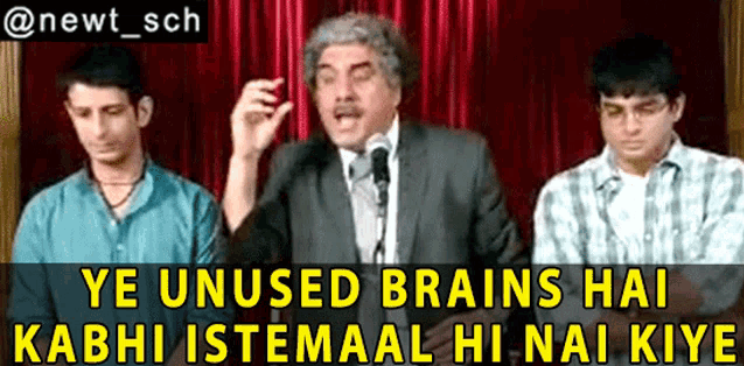
(Source: The film ‘3 Idiots’)
- Algorithmic monoculture and outcome homogenization (everyone’s AI has the same brain): Let me explain this in English. Algorithmic monoculture occurs when many decision-makers rely on similar algorithms to make a particular decision. Similar algorithms might mean the same algorithms or different algorithms trained on the same datasets. Logically this would mean the results may also be quite similar. This is called outcome homogenization.
Read more on this: Does Algorithmic monoculture lead to outcome homogenization?
A simple example is a person applying for jobs who keeps getting rejected because every firm uses the same software during the early stages of recruiting. This is not even hypothetical – >1000 companies (including >60% of Fortune 100 companies) rely on HireVue – same algorithm, same filters, same rejections…
- Herding risk: This is related to the one above. It is a risk where traders make similar decisions due to algorithmic monoculture and outcome homogenization. This type of AI-related herding risk is a concern, as it could enhance systemic risk in financial markets, particularly in times of price volatility.
It has even been identified as a potential risk by the Congressional Research Service, USA.
- Erosion of self-awareness and increased overconfidence: A study published by Aalto University found that AI use flattens or sometimes reverses the Dunning-Kruger effect (a cognitive bias where people with low ability in a specific area greatly overestimate their own competence there). With the rising use of AI, people lose the ability to self-assess one’s own performance accurately. They tend to overestimate their abilities. You can read about the 2026 study: AI makes you smarter but none the wiser: The disconnect between performance and metacognition.
- Attention span: You’ve made it this far into the article. Well done. But if your attention is starting to wander, you’re not alone. It could be that my writing is boring you. Some research, however, also suggests the onslaught of technology is making it harder for us to focus, and AI could compound the problem.
A Practical Guide to Using AI Without Losing Your Mind
This may sound alarming, and in many ways it is. But this doesn’t mean that we should shun AI. The solution isn’t Luddism; it’s intentionality. Instead of engaging with it as a crutch, you should use it as a tool. Some good and simple AI practices that I (a novice) have learnt from watching other smart folks would be:
- For deep learning, the output is not the end goal: The output is a starting point through which learning is going to happen. Alternatively, AI could be used to automate all the grunt work so that you’ve saved more time for deep learning.
- Don’t just blindly accept what the AI says: If you wouldn’t accept a stranger’s answer to your question, then the same rule should apply for AI. You should form your own judgement first and then use AI to challenge or pressure test it.
- Develop base competence and build on top of it using AI: Like pilots who master manual flying despite autopilot, you should follow traditional training to gain real expertise. This is important, even if AI seems faster. Once you have that strong foundation, you can learn to use AI as an advanced tool.
- Visualization of information: I personally use AI a lot to visualize information. It is excellent in generating interactive charts and analogical pictures which helps me explain lengthy topics to others in a picture or two.
- Ensure sources are verified and tagged: Research insights can be original or borrowed (say from AI). One needs to ensure that sources cited by the AI model make sense and are not hallucinated. One also needs to ensure to let other people know if information shared is AI generated. FYI, I used some help from AI while thinking about the negatives of AI. It was very ironic.
- Work your brain a little longer before using AI: For creative/critical thinking tasks, our brains generate unexpected connections only when given time to struggle. Instead of surrendering to AI immediately, spend some time with a blank page and work on your original ideas. One could use AI to refine the original work later.
All in all, AI should surely be used, just with care. AI is powerful because it makes thinking faster, cheaper, and more accessible. But speed is not the same as wisdom. The goal should be to use machines to complement human intelligence, not to replace it.
As I was typing this essay on MS Word, I made enough grammatical errors that it would’ve provoked my English teacher. However, thanks to the auto-check feature (another AI application), I corrected most of the errors. While it’ll make my teacher less angry, I will be atrophying my grammatical abilities, cheers.
Disclaimer: Views are personal.
Statutory Disclaimer:
https://amc.ppfas.com/schemes/riskometer-with-media-disclaimers/
Leave a Reply